

ACADEMICS
The Field School Program
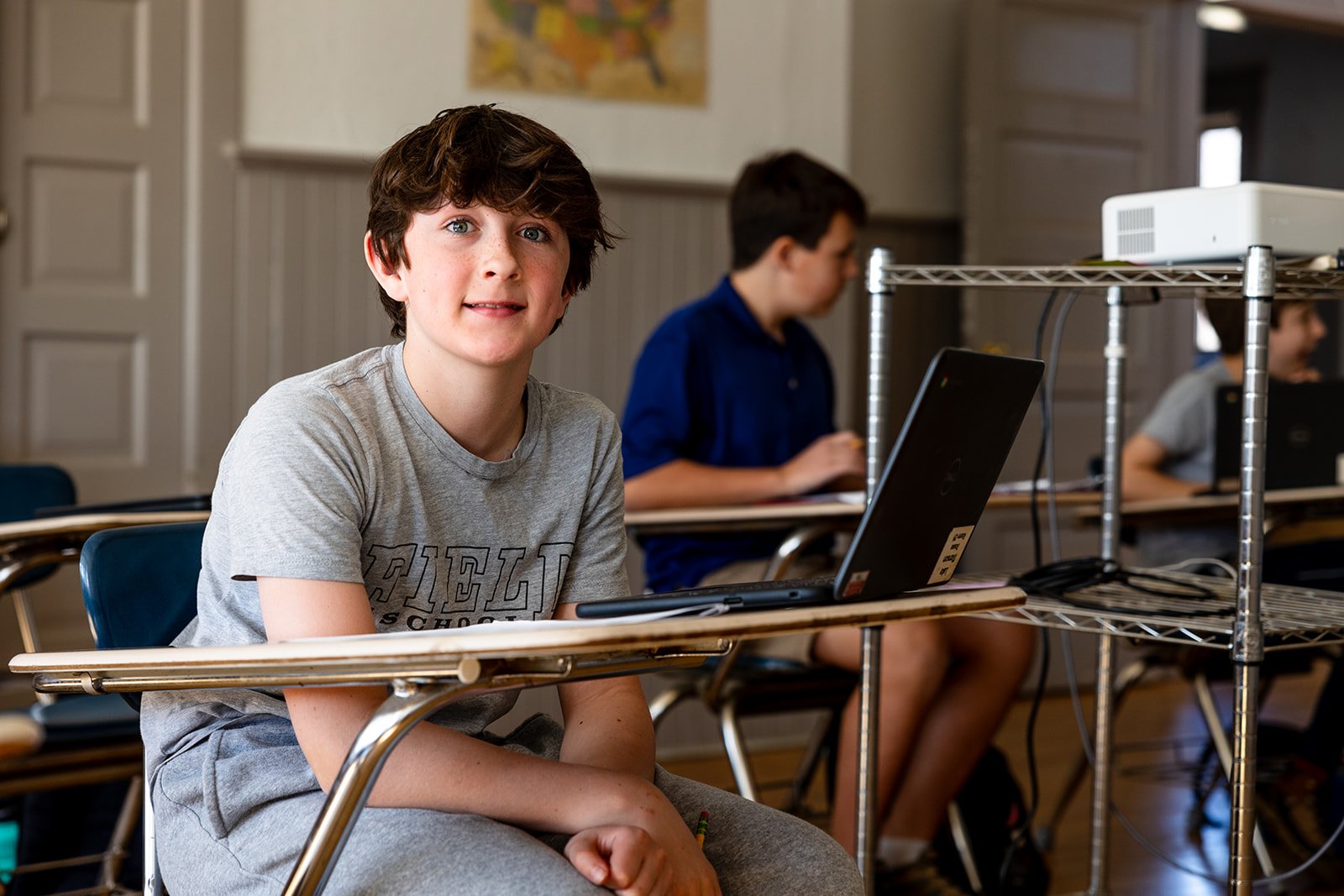
Field School delivers a traditional academic curriculum via progressive teaching and learning strategies specific to the needs of adolescent boys. Our daily schedule is designed with middle school boys as our only focus. Students attend classes in language arts, history, math, science, foreign language, and art on a rotating schedule that allows frequent breaks for physical activity. Each day includes a study hall to allow boys to organize and start on homework. A chef prepares healthy meals daily to expand students’ culinary palettes. Field School consciously attends to developing the whole boy — we strive for a balance of academic, social, physical, ethical, creative, and personal development for each student.
-
English courses focus on strengthening literacy, communication, and command of language through active and engaging instruction. Students work with a range of literary genres while developing skills in writing, speaking, and analysis, with frequent opportunities for discussion and expression. English 5 and 6 emphasize novel studies across multiple genres, along with units in poetry and short stories, with writing mechanics and grammar skills included in every unit. English 7 and 8 include six thematic novel study units with writing and spelling skills interwoven throughout. Our goals and objectives include:
• Reading carefully and thinking critically about a variety of texts
• Writing with attention to form and structure to support clear expression
• Strengthening speaking, listening, reading, and writing skills
• Building proficiency in grammar, mechanics, and editing
English 5 | English 6 | English 7 | English 8
-
The goal of the mathematics program is to help boys develop basic mathematical skills and apply them with precision. The boys should develop discipline, patience and persistence in problem solving both in school and life. Using this symbolic language, students should be able to communicate the usefulness and power of mathematics.
Math 5 | Math 6 | Math 7 | Topics of Algebra | Honors Algebra I | Honors Geometry
-
Science courses take an integrated, hands-on approach to earth, life, and physical sciences. Students build a foundation in scientific knowledge while actively engaging in experiments and inquiry that reflect the curiosity and energy of middle school boys. Through lab work and investigation, they develop precision, critical thinking, and an appreciation for the natural world. Our goals and objectives include:
• Applying the scientific method through observation, experimentation, and analysis
• Writing clear and structured lab reports to communicate findings
• Exploring key concepts across physical, earth, and life sciences
• Strengthening critical thinking through investigation and problem solving
Science 5 | Science 6 | Science 7 | Science 8
-
History courses explore significant periods, individuals, and events through active learning and discussion. Instruction is designed to engage middle school boys with meaningful connections to geography, culture, politics, and economics. Students build knowledge while developing skills in analysis, interpretation, and thoughtful debate, helping them understand the relationship between past and present. Our goals and objectives include:
• Examining key events and figures across world and American history
• Analyzing historical developments through discussion and debate
• Writing clearly through informal and research-based assignments
• Connecting history with geography, culture, and society
History 5 | History 6: World History I | History 7 | History 8: US Civics, Government, and Philosophy
-
Students begin their study of world languages with Latin in the 5th and 6th grades. The focus in these classes is on world language exposure, the fundamentals of language study (such as grammar and vocabulary), and cultural exploration. We aim for students to leave 5th and 6th grade Latin with a love of language learning, an understanding of Latin’s grammatical structure, and appreciation of the Roman culture.
After learning an introduction to world languages in 5th and 6th grade Latin courses, students further their language acquisition through the study of Spanish in the 7th and 8th grades. The focus shifts from exposure and appreciation to the practical application of a language widely spoken throughout the world.
Latin 5 | Latin 6 | Spanish 7 | Spanish 8
-
The arts program includes exposure to a wide variety of forms of artistic expression and hands-on or active practice, including fine art, crafts, music and drama. All of these classes are taught in seasonal blocks, varying in their length depending on the field. Topics include drawing, printing, printmaking, painting, sculpture, ceramics, art history, music theory, music listening, harmony, melody, rhythm, reading and writing music, and singing.
Art 5 | Art 6 | Art 7 | Art 8
-
Our health curriculum covers a wide range of age-appropriate topics that build upon one another in the advancing grade levels. Field School employs experts in the field of health each year to support the growth of our students. Every year of health builds upon the previous year: the material becomes more complex, and the courses include additional, age-relevant topics. The focus is to support healthy relationships and to make sound, informed decisions regarding their physical, emotional, and mental well-being. Health faculty encourage honest, open, and respectful conversation and questions.
Health 5 | Health 6 | Health 7 | Health 8
Curriculum
Character
Development
Developing
well-rounded boys of character and accomplishment
Focusing on the emotional and social growth of our student body is an integral part of the philosophy at Field School. Character education is embedded in every aspect of our program; we see it happening organically at recess and on the playground, as well as through our classroom curriculum.
Our character education classes meet three times each trimester. Our boys learn the importance of respect, inclusion, courage, responsibility, citizenship, and communication. These values are taught through lectures, readings, videos, guest speakers, and by volunteering in our community.
We also find ways to reinforce these ideals through the daily actions of our faculty and staff, by holding students accountable to standards, and developing well-rounded boys of character. Our aim for this program is to help guide our boys into valuing the importance of responsibility, ethical behavior, and becoming exemplary citizens and future leaders.
